

When I sat down with the ewigbyte team at the 65th edition of the IT Press Tour in Athens, the conversation quickly moved beyond storage speeds and price per terabyte. Their focus is far more fundamental. They are asking whether our current approach to preserving cold data still makes sense in a world producing information at an unprecedented scale.
ewigbyte is building a new category of cold data infrastructure by writing digital data directly onto glass. Their goal is to protect information that society cannot afford to lose, not for years or decades, but for thousands of years, without the constant maintenance, energy use, and migration cycles that define today’s storage systems.
A Growing Gap Between Data Growth and Storage Reality
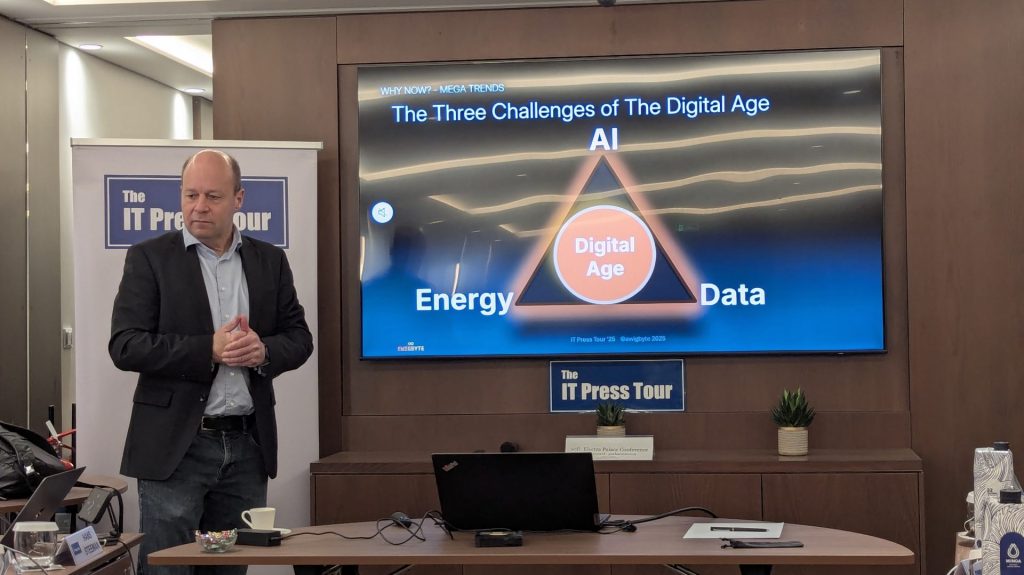
The company’s founders believe the storage industry is heading toward a structural mismatch. Data volumes are rising far faster than the capacity of traditional storage manufacturing. Hard drives, SSDs, and tape are approaching physical and economic limits, while demand continues to accelerate, driven by AI, regulation, and long-term retention requirements.
At the same time, most enterprise data is cold. It is written once, accessed rarely, and kept largely for compliance, historical record, or future reference. Yet it is still stored on media designed for constant updates and rapid access. That mismatch brings cost, complexity, and risk.
Some vulnerabilities are rarely discussed outside specialist circles. Magnetic and electronic media degrade over time. They are susceptible to heat, humidity, radiation, and electromagnetic interference. They depend on uninterrupted power and controlled environments. And they rely on software layers that can be compromised or altered.
From a sustainability standpoint, the model is becoming harder to justify. Preserving cold data today requires significant electricity, water for cooling, and a steady churn of hardware that contributes to mounting electronic waste.
Why ewigbyte Chose Glass
ewigbyte’s answer is to remove electronics from the equation entirely. Their system uses ultra-short-pulse lasers to physically engrave data onto glass surfaces. Each laser pulse creates microscopic, permanent structures that encode information directly into the material.
Once written, the data cannot change. There is no magnetic field to decay, no charge to leak, and no software layer that can silently rewrite history. Glass is inherently resistant to heat, water, radiation, and electromagnetic events. Modern glass, based on existing aging studies, can remain stable for well over 10,000 years.
Rather than chasing extreme density, ewigbyte prioritizes speed and parallelism. Their approach writes entire data blocks at once, allowing practical read and write throughput while accepting that physical space is no longer the primary constraint it once was.
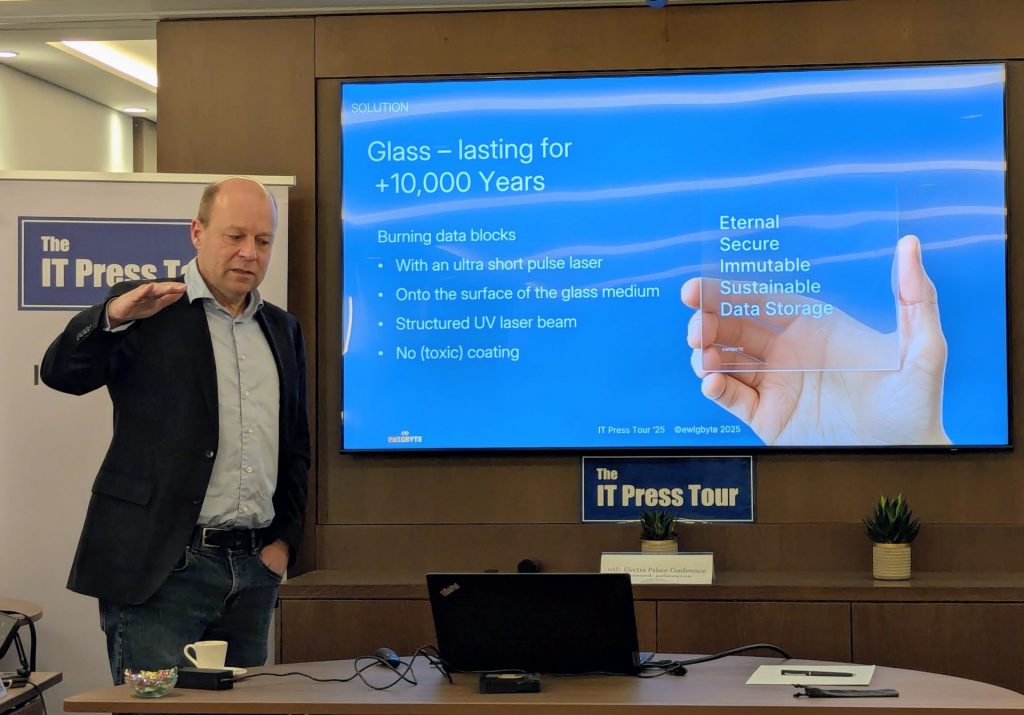
One of the most striking aspects of ewigbyte’s approach is its handling of security. Instead of stacking protections on top of software, they push trust down to the physical layer. Once data is etched into glass, it cannot be modified without obvious damage.
The team also plans to integrate physical authentication features directly into the glass, similar to techniques used to secure currency. This enables verification that the data is original, unchanged, and tied to a specific physical artifact. It also provides resilience against threats like ransomware, silent corruption, and unauthorized alteration.
Warehouses, Not Data Centers
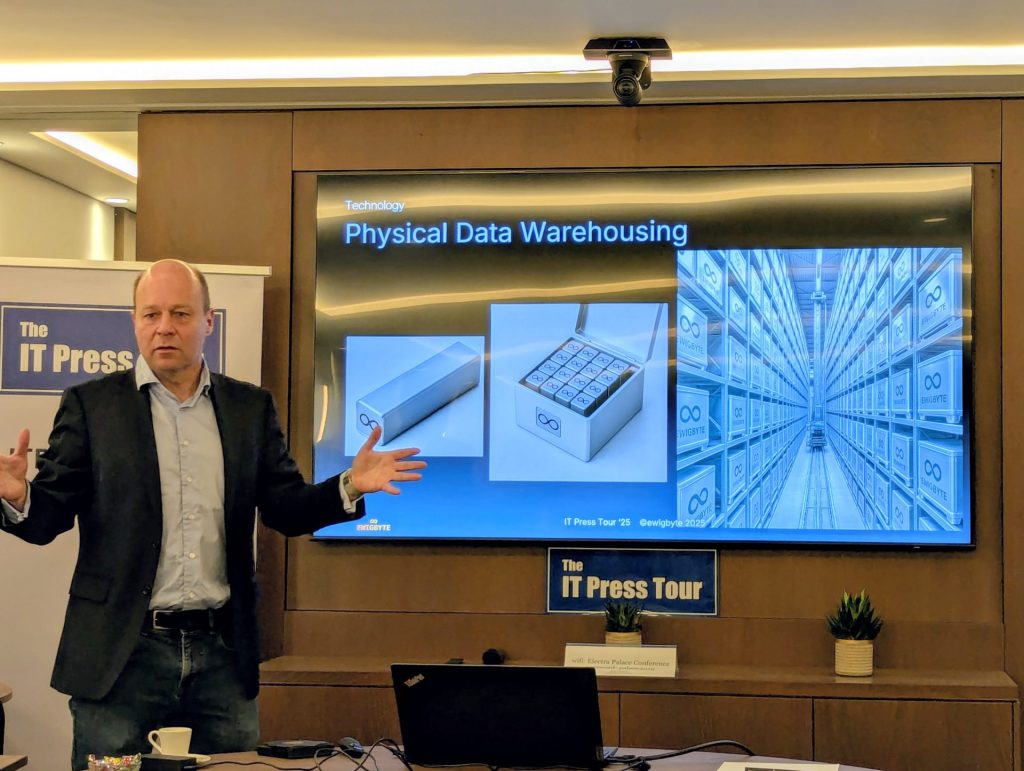
ewigbyte does not plan to sell hardware or drop racks into existing data centers. Their long-term model is storage-as-a-service, delivered from facilities explicitly designed for cold data. Instead of power-hungry environments packed with compute, these locations would resemble automated warehouses. The emphasis shifts to physical security, robotics, and logistics rather than cooling and constant electricity. Data can be written, stored indefinitely without power, and retrieved at scale when needed.
This model also enables parallel retrieval. In scenarios like ransomware recovery, where large volumes of data must be restored quickly, multiple glass cartridges can be read simultaneously, avoiding the long delays associated with tape-based systems.
Why This Conversation Matters Now
What makes ewigbyte compelling is not just the novelty of writing data on glass. It is the context in which this idea is emerging. AI-driven data growth, rising storage costs, concerns about data sovereignty, and mounting sustainability pressures are all forcing infrastructure leaders to revisit long-held assumptions.
Cold data has long been treated as a lower tier of the storage hierarchy. ewigbyte is arguing that it deserves its own purpose-built infrastructure, optimized for permanence, integrity, and long-term trust rather than convenience.
I will be keeping a close eye on how this develops. If you had the opportunity to interview the ewigbyte team on a future podcast, what questions would you ask? Let me know, and I will try to get you the answers in a future podcast episode.


